Lime scale, or scaling, is a mineral accumulation that forms wherever hard water flows or comes into contact with another surface. These deposits have a major impact on the efficiency and lifespan of all appliances, from water heaters to home coffeemakers.
Throughout the Hawaiian Islands, lime scale is especially prevalent where there are more minerals in the water. These minerals are a result of our Island’s natural filtration system in which water flows through lava rock and into our aquifers.
When dissolved in water, minerals take the form of positively or negatively charged atoms, known as ions. When these ions experience a change in water pressure — even as subtle as an elbow turn in a pipe — or a change in temperature, such as inside a solar, traditional, or tankless water heater, they crystallize on the closest available surface, primarily the surface of pipes.
Once the lime scale starts forming, the ions act as molecular magnets, drawing out more and more minerals from the water onto the crusty buildup. As the coating thickens it constricts the water flow, which in turn puts more strain on pumps and filters.
In homes, lime scale is commonly manifested as white spots on shower doors and dishes or as a crust on bathroom fixtures. Although less obvious, these calcium deposits are also responsible for leaky faucets and clogged shower heads. A long wait for hot water is often an indicator that the water heater pipes have been coated with lime scale causing the water to be insulated from the heating elements.
On a commercial level, the accumulation of lime scale significantly raises operating costs by decreasing energy efficiency and increasing downtime for maintenance and repairs. Large commercial air-conditioner systems are extremely susceptible to lime scale, especially in Hawaii where the water has higher concentrations of salts and minerals.
How big a problem is lime scale? Just a small coating of lime scale of 1.6mm (.06") on a heat exchanger in a boiler system can reduce its efficiency by an average of 15%. As the scale increases, the efficiency losses rise dramatically.
A New Mexico State University reports that by reducing and preventing limescale buildup on pipes and appliances, households could experience 30% savings in energy costs which averages approximately $1,100 a year. In Hawaii, where we have the highest electric rates in the nation, the savings can be even greater.
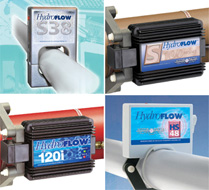
HydroFlow technology has been available for more than 18 years and is used in more than 42 countries. It was introduced in the U.S. about three years ago as American businesses started looking for a greener, chemical-free method of preventing and removing lime scale.
HydroFlow works on a molecular level by inducing a randomly varying electric current that is carried in the water throughout the system. The signal produces high-frequency diminishing waves with random wait periods which force the positive and negative ions to keep changing directions. This, in turn, increases the opportunities for the ions to bind to each other and form “seed crystals" rather than binding to the pipes. In simple terms, HydroFlow generates an electric current that causes mineral ions to naturally clump together and wash away.
This action is both preventive as well as restorative. The random current generated by the HydroFlow unit covers the entire electrical wavelength, affecting all the minerals within the system. As the minerals “clump” together and are suspended in the water, they also attract ions from existing deposits. Due to the charge, the ions become more attracted to the suspended clumps than the pipe, and so they eventually break away.
The problem caused by lime scale is similar to cholesterol and arteries. The greater the plaque buildup, the more constricted the arteries become. This, in turn, restricts blood flow, taxes the heart and ultimately, creates an unhealthy situation.
HydroFlow prevents the “plaque” or lime scale from sticking to the “artery” or pipe walls. It also removes “plaque” as it travels through the “body.”
Two hard-water treatment alternatives to HydroFlow are acid washes and salt treatments. Both chemical treatments require significant downtime to flush high volumes of water through the system. These temporary treatments need to be repeated on a consistent basis, which means salt and acid are discharged back into our sewer system and ultimately back into our aquifers. While salts and acid may slow the mineral accumulation, it does nothing to remove existing blockage.
HydroFlow uses nature’s own green nanotechnology to prevent and remove lime scale. The electric current induced by the HydroFlow unit works within the house, condominium or business where it is activated. This means that the minerals return to their normal state when they exit the system.
Water treated with the HydroFlow system is also safe to drink. Unlike osmosis which removes all minerals that naturally occur in water, HydroFlow retains all elements so that the water tastes exactly the same.
One HydroFlow unit can protect an entire home, is safe for all pipes, and can be installed by a homeowner in a matter of minutes without cutting the pipework. |